HANDLE WITH CARE

When people are in control of their history, they are able to build community, wealth and stability. At the very least, they have control over their identity. But when that sense of your own culture and history is lost, it takes generations to control and solidify that identity again.
– Andrew Voogel

When granny and grandfather were stolen from the islands, all island practice and tradition was stolen too. Our people were made to speak English and even call their children English names. Our culture is a combination of island traditions fused with culture inherited by the plantation owners.
– Jasmine Togo-Brisby

I

Throughout history, external forces have disrupted and re-routed the trajectory of unsuspecting lives being lived in far off lands. Sugar production — the foundation for much of the British Empire and an insidious driver of slave labour — has been one of the most violent influences. From the Spanish and Portuguese impact in the Atlantic Islands to the arrival of the British and French in the Caribbean in the early seventeenth century, the expansion of sugar plantations and the laborious task of sugar cane cultivation drove an insatiable demand for labour, in turn accelerating the trade of African bodies.

With the gradual emancipation of African slaves from the early 1800s, plantation owners looked for alternative sources for cheap, or free, labour. John Gladstone, a British Statesman and sugar plantation owner living in British Guyana, turned his thirst to India. He arranged for hundreds of Indians to be brought over to work in his fields. Many followed his lead, including European Colonial plantation owners in the Caribbean islands, such as Trinidad and Jamaica, and South American mainland countries, Guyana and Suriname. Over the next 80 years, hundred of thousands of Indians would be deceived, coerced and forced onto boats to cross the seas and satisfy the desire for cheap labour.

II

One of the Indian individuals deceived into indentured labour was Sita, a 22 year-old married woman with a daughter named Kwaria. In January 1911, Sita was offered overtime at the factory where she worked assembling dolls for a British company. She accepted, leaving Kwaria with a neighbour. When Sita arrived at work, she, along with other factory workers, were forced to walk to the Port of Calcutta, a trek that took nearly a week. Along the way, hundreds of other Indians were collected. These individuals, uprooted from their homes to work on the sugar plantations in the Caribbean, along with the numerous others hoarded then herded onto ships, would collectively come to be known as the Jahajis: ship travellers. Sita would never see her daughter again.

Andrew Voogel, a descendent of the Jahajis of Guyana and Sita’s great-grandson, recalls this moment of violent departure. The title of his installation — Kalapani: The Jahaji’s Middle Passage — co-opts the phrase ‘The Middle Passage’, which refers to the ‘triangle’ trade route between Britain, Africa and the West Indies, traversed to ship trading goods from England to Africa, slaves from Africa to the Caribbean, and processed harvests back from the Caribbean to England. The Middle Passage, however, doesn’t fully account for the experience of Indian indentured labourers. Kalapani: The Jahaji’s Middle Passage names the lesser-known sea voyage that those captured were forced to undertake. Kalapani, which translates into English as ‘black
water’, also references a traditional Hindu taboo on crossing the sea, which could result in an individual losing their caste status. The passage to the Caribbean was therefore doubly-violent, not only uprooting a person from their family and home, but also from an observance of their own self-determined ways of living and belief systems.

Voogel’s installation includes video focussed on a single point in the ocean, projected in a darkened room. The work invites contemplation of the vast waters. The artist’s intention is that a viewer, plunged into darkness, will gradually perceive the image. Asked to occupy an empathetic moment of uncertainty, the viewer can grasp their own understanding of the sea. Might it be as a site of trauma, an archive for history, a possible place of healing?

Displayed alongside Voogel’s video projection are the passage papers that record the arrival of the artist’s great grandparents, Sita and Bhoja, to Guyana as indentured labourers. These documents, known as Colonial Form No. 44, reduced individuals to a series of details that assessed their suitability for labour. The juxtaposition of the video and documents reflect two different ways of thinking about history: through its formal, bare documentation that are the end result of a power imbalance, or through something more speculative that allows room to imagine the experience and feelings of the people who lived through them.

III
In an adjacent gallery space, a mass of skulls cast in resin and sugar sparkle eerily in gallery lights. This installation bonds together motifs of death, sugar and anonymity. Despite the horror of the skulls, the sugar crystals glint seductively. The effect is unnerving, calling to mind the fact sugar, like tobacco and rum, was never a basic necessity. Rather, slave economies were supported by the consumer’s desire for a leisure product; a recreational sweetener that distracted from the atrocities.

In the late 1800s, the lure of sugar spread to Australia, where the Queensland government encouraged the establishment of sugar cane plantations. Lacking the once steady stream of labour from incoming convicts, the government and plantation owners turned to the Pacific. 62,000 recorded — and many more unrecorded — islanders were kidnapped and enslaved on these plantations from 1863 through to 1904. This history of is often referred to as blackbirding, a widely used but euphemistic term that romanticises a Pacific slave trade.

The peoples that were forcibly migrated to Queensland to work on plantations became known collectively as South Sea Islanders. In the early 1900s, a White Australia policy prompted the deportation of South Sea Islanders who were still alive in Queensland. Many, however, stayed, and a small community exists to this day. Jasmine Togo-Brisby, an Australian South Sea Islander, has an arts practice that is personally
motivated: like Voogel, her great-grandparents were among those coerced into indentured labour. Her great grandmother was only eight years old when she was stolen from Vanuatu. Togo-Brisby’s work considers how to create spaces for healing by acknowledging this recent and still raw yet largely under-recognised past. Bitter Sweet, made from 2012 to 2013, was prompted by the unmarked mass graves being
unearthed by Queensland farmers. Much of the history around indentured labour privileges documentation: the numbers of labourers taken to Queensland, quoted in the vast majority of texts, are based on the number of extant documents. Bitter Sweet points to the undocumented labourers, the voiceless who are unaccounted for in history.

As a meticulous process, casting is one that has a particular duration. Though the cast skulls are multiples, each has been individually handmade, going through a process from finding the right liquid ratio of raw sugar and epoxy resin, to pouring, then solidying, and then prising open, and finally to maintaining the integrity of the objects. There is a intimacy that the artist shares with the works, that counters the disregard for human life expressed by plantation owners and slave traders.

IV
The wounds of the recent past are still being peeled back, with new information being
unearthed and fuller recognition still being sought.4 The importance of recalling these
specific histories — which for both artists is still very much present in their families, traceable to a specific person only a few generations removed —seems self evident. The contemporary condition of their respective cultural communities are inextricably linked to histories of indentured labour. Notably, the terms South Sea Islander and Jahiji are used to describe a group of otherwise diverse peoples, formed by the process of forced migration.

Speaking within the context of Aotearoa New Zealand, a country very much shaped by
histories of colonisation and migration, curator and artist Ahilapalapa Rands considers how we grapple with confronting histories. She writes:

We can’t move forward until we know where we are right now, and where we have been. But there is an emphasis on care that I think is important. How do you acknowledge the painful shared histories we have, especially in spaces like Aotearoa that have been shaped so heavily by colonisation and imperialism? And within that acknowledgement, how do we empower through challenging and recontextualising the archive’s narrative, while avoiding reproducing that trauma?

This question of how to remember but not re-enact trauma is central in the work of Voogel and Togo-Brisby. Drawing upon oral traditions as the primary archive, both Voogel and Togo-Brisby instill an emphasis on ‘care’ in their works. As stories surface and are passed down the family line, these works require from the artists a degree of care as guardians for their familial memories. But the works also look forward, thinking about what role they may have in opening a space where their communities can feel recognised, to have their stories told in a public place.

Yet when we turn to remember the past, we often rely on records. Voogel’s work notes that indenture documents, which reduce a person to their biological markers, are all that might be recorded of his grandparents. Similarly, texts on South Sea Islanders use the records on contracts to estimate the number of indentured labourers. Even in writing this essay, it seemed inescapable to begin with a skimmed history that focused on macro shifts rather than humanising those who have been historically treated economically.

It seems to me that part of approaching traumatic histories with care is to recognise and create archives that exist beyond the practices of recording that were in themselves tools of exploitation; reductive and deadening, using documentation to speak of history like a fixed, finished moment. Kalapani: The Jahaji’s Middle Passage and Bitter Sweet are both marked by an absence. What we are asked to encounter are the silent passing of waves and presence of unnamed skulls. The works are emotive, promoting a response rather than dictating historical data. In this space, there is room to reclaim histories that cannot be recorded beyond what can be held in a real or imagined memory.
Beyond the display case

11223792_10205317296715512_7241609891468098890_n

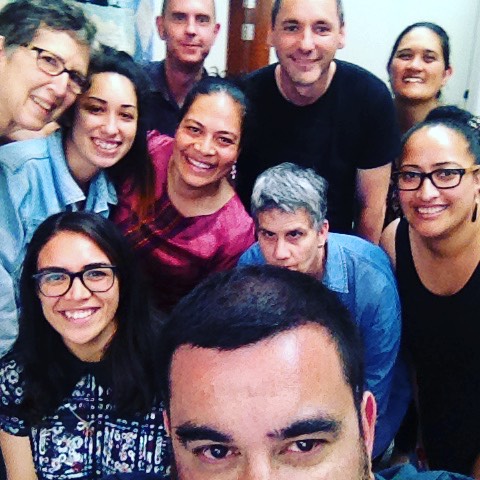
I know it might seem odd to start with a group photo, but I wanted to begin this talk by first introducing how I position myself within the New Zealand contemporary art landscape.

My arts training began at Victoria University of Wellington, where I studied Renaissance and neo-classical Art History. My foray into a contemporary art sphere only began when I moved up to Auckland to work in a diverse range of galleries, including Objectspace, which focuses specifically on craft, applied arts and design and Artspace, which positions itself at the forefront of international contemporary art. I’ve also interned, produced exhibitions and written for Tautai Contemporary Pacific Arts Trust: an Auckland-based arts organisation that supports and promotes artists of Pacific-ancestry. Being part of this community has given me access to a thriving hub of Pacific diaspora artists, and in particular introduced me to a group of emerging artists of Pacific Island descent, who share a similar background to me: New Zealand born and often tertiary trained. I consider these artists to be my peers, and often my mentors too.

These experiences have shaped me into something of a ‘generalist’ curator within a New Zealand context. I’m glad to now be curator at Te Uru Waitakere Contemporary Gallery, a recently opened space in West Auckland. We have a broad remit and notably, the word ‘art’ isn’t in our gallery name: a signal that we wish to embrace to a wide range of practices and material culture.

At a recent workshop I attended, where this photo was taken, we were asked to introduce ourselves by stating what ‘master’ we serve, which I thought was a great way of declaring our personal agenda. As a ‘generalist’ curator, I have to say that my current allegiance is to the artist. My curatorial drive is to enthuse: to share with audiences a genuine love that I have for the artists work, and to ensure that the artists voice still has a presence despite other institutional priorities.

Despite having this very personal, rather than political approach to curating, when it comes to working with contemporary Pacific arts for a New Zealand context, it feels like the political is impossible to avoid.

With that in mind, I wanted to present two things in this talk:

  • The first is a key issue I’ve encountered when presenting ‘contemporary Pacific art’
  • The second are a couple of curatorial experiments that attempt to negotiate this issue.

MY FIRST EXPERIENCE WITH THE POLITICS OF PACIFIC ART CAME EARLY.

In 2013, I was commissioned by Tautai to curate a performance series to accompany an exhibition at the Gus Fisher Gallery, produced by Jeremy Leatinu’u and Kalisolaite ‘Uhila. In developing this two-week performance series, I was asked specifically to work with artists of Pacific heritage.

The provocation for both the existing exhibition and the performance series was the site itself. The Kenneth Myers Centre has been the setting of some of the most pivotal moments in New Zealand’s performance history. It has functioned as a government-owned national radio, a home for a number of television stations, rehearsal and recording spaces for many local musicians, and is now a School of Creative and Performing Arts.

Interestingly, this history is rendered invisible because of the building’s architecture. Its 56 cm, double-layered brick walls and the triple-glazed glass prevent sound from travelling in or out of the building. Furthermore, from street level, you can’t see the three stories that descend below the slope.

Jeremy Leatinu’u, Spatial Resonance, 2013, moving image still
Terry Faleono and Pera Afato, Umbrella, 2013, performance documentation
Nastashia Simeona-Apelu, Untitled (whip performance), 2013, documentation

The performances sought to disrupt the site’s cocooned nature through a series of interventions: Bringing performance produced in the dance studios into the street, using performance to lead audiences into the cavities of the building, occupying and activating the liminal space between the street and structure, calling out from the roof, and using the body to both create and stifle sound were some of the strategies used by the invited artists. Together, they exposed, interrogated, satired and disrupted the architectural and spatial features that so dominantly demarcate the building from the public.

The performance series was later reviewed online:

Mark Harvey, ‘In Certain Places’, Eyecontact, 8 April 2013.

“[The] project focused on attracting communities not traditionally associated with contemporary art and performance to their site – Pasifika peoples”

“This [the performance series] played with some of the cultural stereotypes associated with Pasifika people as a blue-collar church-going other, particularly in the context of the surrounding white-collar university complex.”

“Gordon-Smith, ‘Uhila, Setoga and Jeremy Leatinu’u were choreographing us into their experience of what it means to explore a colonial building from their position as Pasifika”

“While Leatinu’u may appear on the surface to be pointlessly mucking around, he was playing on the cultural stereotype of the ‘happy-go lucky’ Polynesian, historically until recently an outcast in institutional locations like this.”

Mark Amery, ‘The Fest Test: Pacific Crosscurrents’, The Big Idea, 11 March 2013

“I love how the Pacific Island artistic community with this project have in effect, from the roof to the stairwells, taken over this historic physical symbol of media power.”

These two reviews are totally valid. There is something potentially empowering about a group of young, Pacific-heritage artists occupying a building that is used to transmit images, sound and learning. However, the readings are also somewhat reductive. The spatial engagement with the site was marginalised, and instead imposed assumptions of ‘Pacific exclusion’ as well as ‘Pacific art intentions’ were applied.

These responses are indicative of a much wider problem. It seems to me that contemporary Pacific arts, in New Zealand, suffers from a continued, stereotypical imagining of what it means to make art as someone of Island heritage.

This framing of Pacific arts practice in New Zealand isn’t new. Twenty years ago, the Curator and Artist Jim Vivieaere made a key observation. He wrote:

Contemporary Pacific Art in New Zealand is like a three-legged race. It is both a novelty and a handicap event … and [is] at the same time constricted by the art world itself —which offers only a narrow opening — a vision of an imagined Pacific Island world — through which the work is admitted to a public space [my italics].

I’ve italicised the last section of Vivieaere’s quote (which is an abridged version of his full statement), because in 2016, I would argue that the art world continues to gate keep and perpetuate a narrow vision of Pacific art. This imagining of a Pacific Island world results from a number of factors.

Since the late 1980s, a number of Pacific art group exhibitions have been staged to give visibility to the growing number of New Zealand-based Pacific artists. Curator and Pacific Arts Advocate Ema Tavola notes that that “The more popular and regular these ethno-specific Pacific exhibitions become, the more there was a sense that a Pacific aesthetic emerged.”

Over the years, the idea of a Pacific aesthetic — one that is colourful and motif-driven — has been coupled with an idea of a particular politics, such as identity, diaspora and representation. While these are urgent issues for a number of Pacific-heritage artists, and Pacific diaspora peoples more generally – this homogenisation of artistic concerns continues to be put forward through a process of ‘othering’, a fetisisation of Pacific-heritage artists who are conceived of only in terms of their novel points of difference.

There are two particularly damaging repercussions that result from this imagining.

1: Firstly, it flattens a diverse diaspora of Pacific peoples.

In Aotearoa New Zealand, the ‘Pacific’, when used without qualification, usually doesn’t encompass the full ‘Pacific Ocean’, from which the adjective derives. Rather, the ‘Pacific’ is used more conventionally as an abbreviation of the Pacific Islands; a term that consistently excludes Aotearoa New Zealand and Australia but is otherwise used somewhat at will … this use of the word ‘Pacific’ in reference to a much smaller grouping of nations privileges the most central region of Oceania, maligning other nations without overtly declaring that bias.

2: Second, this imagining of a Pacific World flattens the diversity of contemporary Pacific arts practice, as well as the multiple readings that might be generated from single artworks. In New Zealand, we have an incredibly, rich, diverse, and prolific ‘contemporary Pacific arts’ scene. Nevertheless, the phrase ‘contemporary Pacific art’ is frequently invoked to imply a set of shared artistic concerns, when really what we’re actually referring to is membership in a shared, often peripheralised, community. If the term ‘Pacific’ fails to represent the diversity of peoples from the region, then the term ‘contemporary Pacific art’ groups together that same diverse group of people who are making an even more diverse output of art.

NEW MODE OF CURATION


For me, the primary challenge facing Contemporary Pacific art in New Zealand is the need to reclaim its diversity. Curating offers one means to combat persisting limitations.

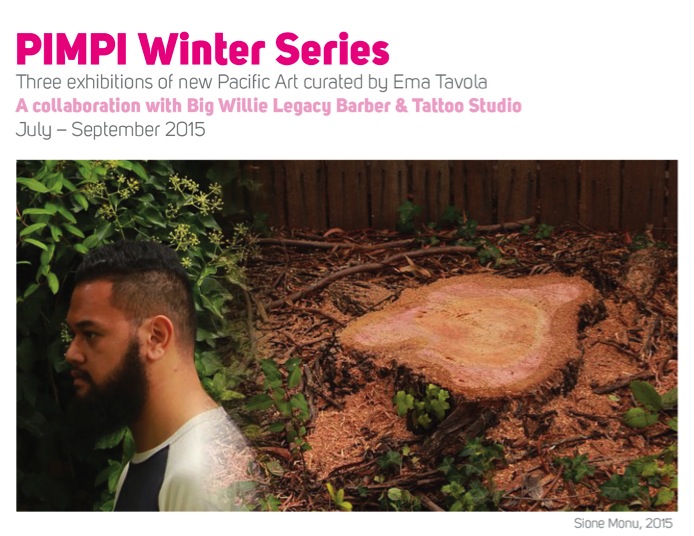
Ema Tavola’s 2015 exhibition That’s not Pacific Art, for example, embraced a new wave of artists, confronting popular expectations of what Pacific art is / should be. It was part of a wider ‘Winter series’ of pop-up exhibitions that took place in a barber and tattoo studio in the central suburb of Mt Eden. Collectively, the series had a self-stated aim of broadening an awareness and understanding of Pacific ways of seeing and being in Auckland.

Pacific Materialities, curated by Natasha Matila-Smith, STUDIO ONE TOI TŪ, March 2015, Image credit: Artsdiary

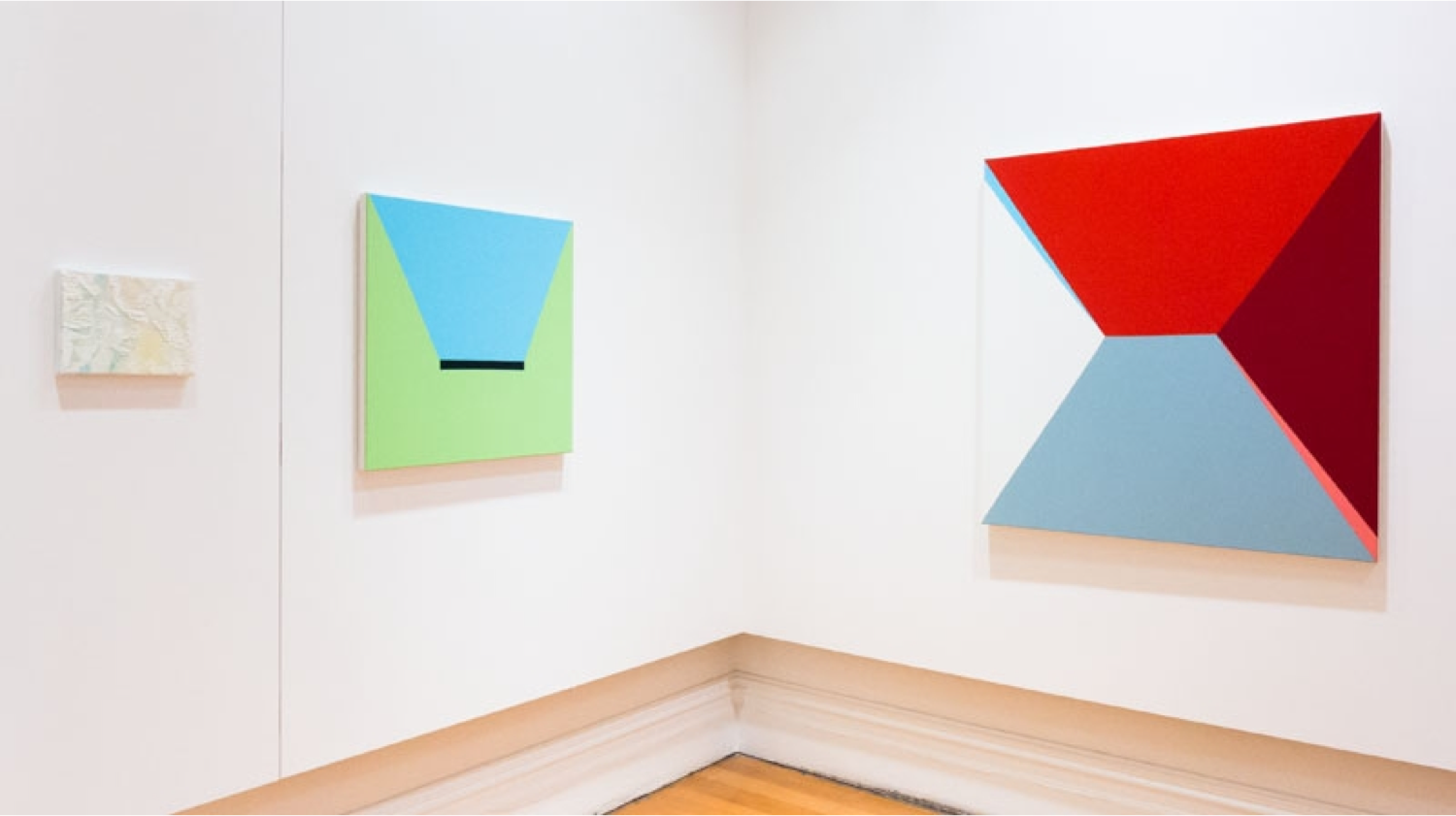
Similarly, Natasha Matila-Smith’s 2015 painting show Pacific Materiality was made in response to “a perceived notion of a Pacific aesthetic”. For the most part, the artists she included in the exhibition weren’t often recognised as being of Pacific-heritage, and the self-conscious positioning within a global lineage of modernist and abstract painting was also defied expectations.

Over the past couple of years, I’ve been trying to negotiate how to curate work made by Pacific heritage artists that reclaims its complexity: acknowledging their Pacific heritage while also allowing space for other references points to come to the fore.


A Sense of Place, Papakura Art Gallery, Auckland, 2014

My first conscious attempt to undertake this was group exhibition co-curated artist and curator Talia Smith.This was another exhibition commissioned by Tautai. Consequently the same agenda from the More Than We Know exhibition applied here too: to support and promote Pacific-heritage artists working in New Zealand.

Talia and I thought the best way to achieve this was to position the work of three Pacific artists — Jeremy Leatinu’u, Salome Tanuvasa and Anita Jacobsen — alongside the work of non-Pacific artists, including some seminal works in recent New Zealand art history, such a Laurence Aberhart photographs, Robin Morrison’s images of Ponsonby Road, a Robert Ellis Motorway painting and a print of Michael Tubberty’s photograph of Dame Whina Cooper at the beginning of a hikoi.

Notably, each of their Pacific artists’ works were place-specific: Jeremy’s video was made in response to fatal hit and run on Church Road in Ōtāhuhu, Salome 16mm film was specific to her experiences growing up on Queen Street in Panmure, and Anita’s photograph captured a dairy at night in Papakura.

Reading the works as informed by their positioning in highly Pacific-populated suburbs was made possible through supplied contextual information. Situated within a wider thematic curatorial umbrella,Talia and I also encouraged audiences to interpret these works as investigations into how public spaces function to choreograph experience.

For me, positioning Pacific arts within wider contexts offers many possibilities for expanded readings. At the same time, I’m also interested in unpacking and interrogating in depth the practices of Pacific-heritage artists in solo exhibitions.

My next project is a collaboration with artist Janet Lilo on a solo survey re-mix exhibition. Janet Lilo is uses digital video, photography and installation to document a variety of situations. She is known for her conviction in championing what is usually-excluded in the art world. With a firm foot in her local community of Avondale, Auckland, an acute awareness of the growing role of the digital in our everyday lives, and an unapologetic interest in the ways that we adapt and define ourselves through popular culture, her practice raises timely questions about the role of accessibility, distance and representation in both the gallery space and the wider world at large.

Despite an approach that is simultaneously vigilant and sprawling, Janet, for me, has often been turned into a poster child for either ‘pop-influenced’ work or a younger generation of Pacific art. The survey exhibition is in part an attempt to re-assert Janet’s expansive repertoire and re-assert the importance of her work in outside of single-lens contexts.

For that reason, we’ve given the exhibition the tongue-in-cheek title ‘Status Update’, which is a nod both to Janet’s well-known use of social media as media, as well as a provocative, self-aware use of the exhibition as a way of clarifying Janet’s position within mainstream contemporary arts.

Furthermore, the survey exhibition takes a deliberately de-centred approach. The remixing of previous works to create new work is both an attempt to recognise that her practice has often been ephemeral, and thus resists re-showing, as well as an attempt to wrestle interpretation of the work away from previous reductive readings into a space where things are defined on the artists’ own terms. As part of that agenda, the exhibition used the four categories of text, image, video and installation as the axes around which Janet explores a number of themes, including all but privileging none.

I wanted to conclue this presentation with a couple of quotes from Janet Lilo, taken from the first issue of Mana Motu, which accompanied with first Contemporary Pacific Arts Festival, held in Melbourne in 2013:

The first articulates her concern to engage multiple audiences:

The difficulty I find with being a consciously educated Pacific/Maori artist is that I am trying to engage with various audiences on different levels without compromising my ideas and to tell the truth I find it really hard. It’s not a matter of trying to please audiences but to have a balance. This is where being dynamic is a challenge for me. The other challenge is related to the context of where work sits in relaon to all of these considerations. I’m interested in making work that is based on simple ideas and is open for discussion at any level of sophistation. I welcome criticism from grassroots to academic equally.

Janet Lilo, Mana Motu, Issue 01, 2013

The second quote questions how we, as arts professionals, frame Pacific-heritage artists, even as they attempt to engage multiple peoples:

When I was on Maori TV , I was presented as a ‘Maori artist’ and when I was on Tagata Pasifika they called me a ‘Samoan artist’ which I found quite funny. My Niuean Grandfather (bless his soul) would be upset with that. I wonder what I’d be if I was on Crimewatch – who would claim me then?

Janet Lilo, Mana Motu, Issue 01, 2013

 For me, the question of who claims contemporary Pacific art is vital. We need more curators, more writers, more academics to engage with Pacific art. And as much as we need more Pacific-heritage peoples in these roles, contemporary Pacific arts also needs to be claimed by generalists. We need to acknowledge that Pacific-heritage artists occupy multiple worlds, and subsequently position Pacific arts in broader contexts where multiple reference points can co-exist in a constellation of possible readings. I fundamentally believe that the more we claim contemporary Pacific art for spaces outside of its current display case, the fuller our understanding of Pacific arts practices will be.


To and fro: a conversation with James Cousins

James Cousins has long been interested in the
contingencies that painting relies upon: how do
we recognise an image? What systems guide our
understanding? What processes might be used to
disrupt these assumptions?
His recent works made from 2009-2015, brought
together for the first time in the exhibition Restless Idiom, unsettle our
expectations of landscape images. Each painting consists
of a reproduced image, mostly sourced from colour plates
in a botanical guide. Though they may be familiar as types
of flowers or trees, layers of paint interfere with their
completion.
The systems used to puncture the image are an important
part of Cousins’ practice. In these works, layers of vinyl
stencils are applied to a base layer (or layers) of paint. An
image is reproduced on top of the vinyl before the stencils
are peeled away, revealing the ground paint beneath.
Cousins often then applies another added interruption,
though here the approach differs from work to work. Rolling
stripes of colour, using spray guns and smearing swathes
of paint are all techniques used to further fracture his
images. The recognisable is consequently de-centralised,
sandwiched between, under and on top of the abstract.
Notably, Cousins’ process involves constantly negating
whatever decision-making process came before, maintaining
a captivating tension between what might otherwise be
perceived as contradictory concerns and effects: the
figurative and the abstract; illusion and materiality; the
surface and the pictorial. The result is a captivating optical
instability not dissimilar to an ambiguous pattern, where the
eye constantly oscillates between seeing the painting as
operating in one way, and then another.
It is in this constant to-and-fro-ing that Cousins escapes
the reductive and binary tendencies of many of paintings’
‘isms’, allowing instead for his works to prompt an active and
prolonged act of looking; one premised on an uncertainty
of the image as well as the paintings’ constructions. By
placing the image into an equilibrial tension with the material
effects of specific processes, Cousins provokes the viewer
to carefully consider what it is that he or she is – or indeed,
isn’t – looking at.
Ioana Gordon-Smith: It seems to me that one thing that distinguishes your practice is how you unite often oppositional aspects of
paint: its illusory possibilites as well as its inescapable
materiality. The combination creates a compelling
oscillation — a sort of constant visual to-and-fro-ing.
Any thoughts?
James Cousins: One of the core motivations for my work at its beginning
was to ask ‘what is a painting? When does a painting
stop becoming a painting? And how does it operate as
an artwork?’ For me, it’s about setting up paradigms,
understanding its limits, and then trying to cross those
thresholds.
There’s a slippage that begins to emerge between how you
understand things perceptually in terms of the space: one
part of the painting will look like its operating one way then
it slips into another part and it begins operating in another
way. There’s a kind of oscillation between things, which
creates a sense of dislocation.
One commentator described the reproduced images
in your works as being specifically insignificant, but
familiar or recognisable. What attracts you to
a particular images or fragments – what are you
looking for?
Initially, at the early stages of the work, when I was working
solely from landscape, I had just returned from living
overseas, and I was looking to try to ask questions about the
legitimacy of images to talk about place in a meaningful way.
If you look at images of New Zealand — say for instance
the ubiquitous images of Mitre Peak — they say nothing
about the place. All they do is talk about a convention of
representation. They might say something if you take a
snapshot that is related to a memory, but when you seen
these images co-opted into tourism for consumption, there’s
a presumed transparency about the conventions that are
used. I was interested in trying to deflate that somehow
rather than deconstruct it. So when I chose landscape
images, they were very banal. I was riffing to a certain extent
off Gerhard Richter, from whom I’d learnt to use images
that are banal enough to allow a gap to occur for viewers
to generate multiple interpretations that aren’t didactic, but
instead ask questions.
If you look at the re-produced images in some of my older
works, you can see that they are simply types: a ridge; a
mountain; a river; a geyser; a waterfall. At the time, I was
interested in that discourse between photography and
painting, with both different types of assumption regarding
representation. There was a period where I was interested in
the painted representational elements being the illusion, and
the abstract being the real.
I then started working from photographs of flowers, for a
similar reason, but they additionally have a history of being
used in imagery as conventional symbols of beauty.
Can you talk a bit about the processes you use to
disrupt or deflate the image? In your earlier works, you
applied thin strips of masking tape to the canvas, often
in a grid-like arrangement, before painting an image and
removing the tape to reveal the ground beneath. More
recently, you’ve used vinyl cutters instead of tape and
introduced mechanical process or spray guns at some
points. What technologies do you employ and what do
they do for you?
The masking tape was an earlier device I used. My earliest
works using flowers had incredibly small, 2mm-diameter
dots made with masking tape covering the canvas, on top
of which I painted the image before removing the dots.
There were hundreds of dots — we had dot-removing
parties. It had an effect where if you looked at the painting
up close, it was abstract, and when you moved away, you
saw the image.
I had been working with a machine where I can apply a
whole lot of arcs into a piece of vinyl. And then I would
turn the canvas 90 degrees and cut the arcs again. So you
have this literal mapping of space outside of the support.
Before I started cutting the arcs, I would make a drawing of
the canvas by putting it on the floor, laying down a piece of
paper that was the same size on top and pouring black in
onto it. I would then use the physical characteristics of the
canvas to create a kind of mark, just picking up the canvas
and holding it for 1,2, 3, 4 ,5 counts. These were just rules
I would create because otherwise I didn’t know how to
engage with the work. But I would make rules and then try
to break them. So if I began by picking up the canvas from
one side and then another, I’d think, well, why can’t I pick it
up from the corner? And then things become complicated,
which is good.
Initially the stencils were one offs. The more recent
introduction of the vinyl cutter into the process allowed me
to make multiple stencils, broadening the scope of how I
used the screens. Of course this also introduced the use
of a computer into my practice and has had an influence on
how I approach the drawing of the stencils.
I’m fascinated in this idea of mapping. It’s a term that
you use quite specifically and it also crops up in Ruth
Watson’s essay Fast paint and interference: James
Cousins’ Signal painting and the de-territorialisation of
the image. Can you tell me more about mapping as it
relates to your work?
As a concept, one can make a distinction between mapping
and tracing. Tracing relies on recognition, in that you’re
merely re-presenting something: nothing’s changed, it’s
referent remains intact. Whereas mapping creates a new
understanding of something – or rather you might not
understand it, but it creates new territory. It means that
the process of mapping isn’t invisible. With photography
perhaps, you assume the process is invisible. These
processes here are for me a form of mapping – a coding.
It’s a bit like looking at a Mondrian: you can understand that
there’s a strict process of making behind the work; but you
can’t necessarily work it out.
It is difficult to decipher the order in which you’ve
painted the layers in your work.
You can explain to people that the reproduced image was
painted last and they still won’t see it that way. It’s related
to the way we think of positive and negative space. I’m not
really interested in the mechanics of the way we perceive
things, but that optical effect of moving between does offer
a ploy to encourage a duration of looking. When the work is
good, it’s about slowing things down.
Do you set up any type of rules or systems that are
deliberately contradictory to create the tensions that
encourage looking?
I think that’s what happens. Out of sheer desperation, you
start making a picture. And often you’ll use another painting
to start. I was pouring painting down something else and I
placed a canvas underneath that caught the drips, so that I’d
have something to respond to. It’s contrived completely, but
then you critique that or respond to it by doing something
that equally contrived but in a different way. You get to a
point where the painting tells you what to do. And perhaps
from there there’s nothing specific to locate about my
engagement with the work or the making of it.
I’m curious about relationship between your use of a
vinyl ‘screen’ and the computer screen. Do you think at
all about your work in relation to the digital world?
I think possibly the works echo something about the nature
of screens without directly talking about that, in the way that
other artists might. When you’re looking at a digital screen,
you’re looking at layers of flat upon flat upon flat: that’s now
how we negotiate space.
For me, though, the idea of screens is more closely related
to trying to create an opticality. There’s an artist who
employs op-like components in her work, R H Quaytman
who I find interesting: I like that way she talks about using
op patterns not to escape vision, but rather to make vision
more visible. You become more conscious of the fact that
you’re looking. The screens allow an image to be placed on
the canvas, but their main role is to activate a consciousness
of looking.
Ruth Watson, in her essay, notes that colour is used to
reinforce “the lacunary effects of looking, denying us
comforting hues or conventional spatial illusions.” How
do you approach colour?
The use of colour has become more complex as the
work has developed. In recent works, at first glance
the accumulation of colours has a tonal or gradient-like
referent. Each of the layers use colour to differing effect,
to differentiate each layer, one layer building upon and
responding to the previous. Colour here is used as a
kind of key or legend that plays with the varying degrees
of transparency, solidity, fluidity, etc. particular to the
process used. In more recent work, I’ve begun to sample
combinations of colours from potential images in a code like
manner, that might be used later in the work and incorporate
them into the layers. For me it’s interesting to see how these
decisions based on what has already happened and what
might happen combine.
It seems to me that your work might find more parallels
with international practices: for instance, you’ve
previously noted that you find resonance with the work
of Gerhard Richter. How does the international scene
inform your work?
Well, I was very influenced by my time in Europe and living
in the UK. I started making work again when I was living
there. Two of the big motivations for that was seeing Robert
Ryman and Gerhard Richter shows and also seeing Barnett
Newman’s work and becoming aware of the heterogeneous
nature of painting. It has this contingent reliance on
materiality but on the other hand it operates completely in
a completely different sphere. There’s something about
painting that’s not definitive: there’s something that’s up for
negotiation in painting.


What do you mean by that?
Well, the only way that I could see any validity in making
paintings was to ask that question: ‘what is this object?’
— but in a way that wasn’t restrained by that legacy of
abstraction in terms of non-compositional strategies and
using systems and processes that allude to the removal of
the hand, eluding any kind of expressive subjectivity so the
resulting works had some kind of legitimacy as ‘fact’. I really
like that idea, but I think it’s impossible.
And reductive too, I think.
It’s very reductive: it leaves begging the question of how the
work engages with the world.
I think there’s a particular kind of rigour about looking that
I’m interested in. Robert Ryman says you have to learn to
listen, to develop a certain kind of literacy, like when you’re
listening to jazz. There’s the same sort of looking that
happens when you look at painting. Whether it’s an illusion
or not, there’s a certain kind of rigour in investigating what a
painting might be afresh, for me anyway.
Restless Idiom covers the period from 2009-2015. Can
you tell me about these years? Do they represent a
particular shift in your process or concerns from what
came before? What concerns are of more significance
to you now?
I think work prior to this period had a focus on a certain
idea kind of contingency in painting. I would combine two
distinct elements, the grid and a sourced photographic
image to heighten the material and non-material aspects
of painting. Put simply, a paintings surface is something
you simultaneously look through as a window and at as a
surface. I was toying with how these ways of looking nullify
or negate each other. When reading the surface the illusion
or representational image is nullified and when viewing the
painting as a kind of illusionist space, its material presence
is nullified. I was interested in how these contradictory
modes of looking activated a potential split and what that
might mean. Eventually I tired of the reliance upon a type
of binary that the work relied upon and how the way I was
using the grid necessitated a kind of exclusion from the
world. I think the works presented in this show still engage
with a certain ideas contingency but they track moves away
from that previous sense of removal.
How do you know when a painting is successful
or a failure?
Failure is when there isn’t enough in there to activate that
durational looking. If the work doesn’t ask you to look at it,
then it won’t ask any questions about what you’re looking at.
Published by Te Uru
Waitakere Contemporary Gallery
on the occasion of:
James Cousins: Restless Idiom
28 November 2015 – 21 February 2016
Curated by Ioana Gordon-Smith
Publication design: Julia Gamble
Paper stock: Spicers Nettuno 140gsm
Edition: 1000 copies
ISBN 978-0-473-34433-7

Blank canvases and empty vessels

Rachel Bell, Empty vessel / Blank slate, 2015, white oak, gold leaf, cord. Photo credit: Sam Hartnett.

Rachel Bell’s practice pivots around questions of transition: when does a material become an object? When does an object become jewellery? In her recent work, her query has magnified in specificity: when does a block of wood with a piece of cord become a block of wood with a piece of cord that you wear on your body? Underpinning these questions is Rachel’s curiosity in how significance and functionality is ascribed to things. Locating jewellery as something we bring into being through our individual and collective projections has consequently guided her current making concerns.

For her Masterworks exhibition, Blank canvas / Empty vessel, Rachel presents 250 pendants. Made from white oak with a think film of gold leaf along the bottom edge, the materials call to mind a number of varied associations: the precious and the natural; the ritualistic and the rural; the ostentatious and the understated. The pendant’s finished form similarly invites diverse readings. For me, the shape is something akin to a toki, an object I closely link with cultural negotiation. For Rachel, the inverted ‘U’ relates to the curvature of her new vessel works or the soft scoop of her ongoing spoon series.

Rachel Bell, Empty vessel / Blank slate, 2015, white oak, gold leaf, cord. Photo credit: Sam Hartnett.

Although these interpretations speak to the “blank” or “empty” open-endedness the works allow, it is in Rachel’s use of multiples that the production of meaning becomes particularly intriguing. As repeated versions of a single jewellery form, the pendants emulate commodities. They re-direct our attention towards mainstream production extending beyond the world of ‘contemporary jewellery’. Fashion jewellery in particular gets a bad rap, but the desire for membership, affiliation or reassurance through a reproduced piece by a known brand, such as Karen Walker (controversial, I know), is a strong pull for many. There are parallels too in contemporary jewellery: think of the fervor for a Ted Noten pink ring. Perhaps the jewellery piece that has the most significance for individuals — the gold wedding band — is at the same time one of the most common and standardised forms.

Unlike commercial jewellery, however, which is usually shown as singular pieces, its ubiquity temporarily placed in suspense, Rachel stages her multiples en mass. The status of each work fluctuates between existing as an individual object, which may have a personal value, and part of a much larger whole, which enters a wider circuit of shared associations. Blank canvas / Empty vessel undercuts the one-off piece from its pedestal. Questions about why we value certain materials, objects and forms apply as equally to the reproduction as it might to the bespoke.

Significantly, Rachel’s work retains the mark of the hand-made. Although the project mimics commercial conditions, the pendants are limited editions and hand-carved. Each piece holds the possibility of a slight permutation. For Blank canvas / Empty vessel, then, it is perhaps in this space where the opportunity to make the multiple an individual exists: in the quiet decision to choose this piece, instead of that.

October 2015

Planting Objects | Yielding Stories

John-Vea_Caution-CleanerJohn Vea, Caution Cleaner

I’ve recently taken to watching short clips of stand up comedy on YouTube before going to bed. During one late night binge, I came across a comedian talking about his past job as a cleaner. He reminisces, “I would be mopping floors, cleaning bathrooms. Nobody looked me in the eye, nobody talked to me. I remember one day I was mopping the floor, and a businessman slipped and he said ‘If the floors wet, you’ve got to put a sign down!’ I’m like, ‘I’m mopping in front of you. I am the sign! You know the little guy on the sign doing this [mimes mopping] – that’s me.”[i]

The joke pivots on the uncomfortable reality that we (‘we’ being implicitly white-collar) often fail to see workers who labour directly in front of us. Whether through discomfort, derision or just sheer obliviousness, we’re more likely to recognise the objects that signal the completion of their duties — the moment when we can consume their labour. At the same time, it is only when the outcome we take for granted, like a clean floor, butts up against the inconvenience of wet floor that we acknowledge that any labour takes place in the first place.

John-Vea_Caution-Cleaner 2

Artist John Vea’s practice consistently confronts us with our habitual blindness. His moving-image work Caution Cleaner (2014), for example, presents a man scrubbing a concrete floor, repeated across four frames. Filmed from above, his beanie-wearing, down-turned face is concealed. With dark skin, he’s evidently a Pacific male, but otherwise the specifics of his being are hidden from the lens. His identity is peripheralised even further as he slowly moves out of each frame, returning only to place a generic but familiar ‘Caution – wet floor’ sign in his place.

Like the comedian’s monologue, Vea’s work speaks to the de-personalisation of working-class or service labour. The repetition of a scrubbing across five frames, echoed acoustically in the cacophonous bristling sounds, parodies a typical production line, where work is piece-mealed, ceaseless and beneficial in no direct way to the worker beyond the return of wages.

The repetition of a monotonous action across multiple frames is a logic also found in Finish this week of and that’s it! (2009/2014). Here, Vea lifts a rock — a material reference to construction work — above his head and holds it there for as long as he can. Like Caution Cleaner, Finish this week of and that’s it! also performs the disappearance of the worker: gradually, but regularly, the figures disappear from each frame with only the rocks left behind to mark the performer-cum-worker’s previous presence.

Interestingly, the labour performed in both projection works is satirically illogical. Scrubbing the concrete floor seems unnecessary (there’s no visible mess to clean), nor does lifting a rock offer any clear outcome. On one hand, this pointlessness serves to highlight the endurance and alienation labourers must go through on a day-to-day basis. However, the works can also be read as a deliberate attempt to negate productivity. In normal circumstances, waged-labour produces a commodity or service that can enter a sphere of monetary exchange. By truncating this process, Vea circumvents a capitalist circuit that translates labour into de-personalised consumption. These actions then have a purposive purposelessness. Without any end product or service, it is labour in and of itself that we encounter, and the person who enacts it that we are forced to see.

Personal stories are also a crucial tool Vea uses to re-humanise workers. His research involves chatting with workers that he meets during his day-to-day movements, and his process can feel more prosaic than purposeful. Vea describes these informal interactions and casual conversations as ‘talanoa’.  The word derives etymologically from ‘tala’, which means to inform, tell or relate, and ‘noa’, which conveys ordinary. “Talanoa”, education scholar Timote M. Vaioleti writes, “literally means talking about nothing in particular”.[ii]

The phrase ‘talanoa’ has become trendy in art discourse. It offers an easy way of claiming cultural mana, and the term is in danger of becoming a cliché. Vea, however, is interested in talanoa as a specific counter to dominant modes of data collection and analysis that reduce interviewees to statistics, a de-personalising approach that bears many similarities to capitalist thinking. Vaiolete argues that talanoa, as a “personal encounter where people story their issues, their realities and aspirations”[iii], offers Pacific peoples more input into policy considerations and consequent benefits than pre-determined, one-sided questionnaires that characterise most research methodologies. The same observation could apply equally to other minority groups. Through talanoa, people are able to become the agents of their stories, rather than objects for research.

Vea’s process consequently has both a conversational and a collaborative character. He seeks to re-tell the stories that he gleans, staying in close contact through the research and making process with the people he has encountered. Notably, Vea often remakes the same work, adapting it to take into account talonoa that he has had since creating the previous iteration. Finish this week of and that’s it! for example, was made in response to a friend’s redundancy, a grim reality faced by many other workers during the 2009 global financial crisis. In 2014, Vea remade the video work for an exhibition at Artspace, Auckland. This gave him a chance to incorporate recent talanoa about the difficulties of living on the minimum wage. For the re-shoot, Vea ate below the poverty line — then $2.25 per week — and the effects on his body are evident across the five frames, each filmed one-week apart. Nevertheless, he admitted in a recent studio interview to being wary of exploiting workers or outing them as whistle-blowers.[iv] Vea looks instead for mundane actions he can re-enact or objects that he can modify to act as metonyms for the realities faced by the people with whom he shares talanoa.

Vea perhaps achieves this most successfully in his responses to the Recognised Seasonal Employment (RSE) scheme. Launched in 2007, the RSE scheme allows employers in the horticulture and viticulture industry to employ immigrants for up to seven months. While seeking to address local labour shortages, the scheme also was implemented with development goals for the Pacific. Consequently, the scheme gives priority to temporary workers from twelve approved Pacific Forum countries, [v]though around 75% of RSE workers come from just six of these: Kiribati, Samoa, Solomon Islands, Tonga, Tuvalu and Vanuatu.

Contractual obligations require RSE workers to remain with their original employer (even though these employers can transfer the temporary worker to other RSE placements at their discretion), effectively hindering workers’ abilities to circulate the job market while simultaneously creating job insecurities. They become then an ‘unfree’ labour force: vulnerably dependent and susceptible to exploitation. Add to this the reliance on others for transport, the ban on frequenting social establishments, the often over-crowded barracks, excessively-long work hours, hidden costs, and limited access to their wages, and the control over their movement become more apparent.

Because of these restrictive conditions, Pacific migrant workers occupy a blind spot in our collective understanding of local economies. In a review of Vea’s 2013 solo exhibition at Papakura Art Gallery, Auckland, sociologist Scott Hamilton noted that temporary workers are difficult for palangi[vi] to conceptualise and subsequently recognise. He writes, the “new migrant workers cannot easily be counted as either members of the Western working class or as inhabitants of traditional, pre-capitalist societies. They occupy a sort of twilight space between economies and cultural codes”.[vii]

Over the past few years, Vea has responded to the workers’ exploitation and subsequent invisibility by making several performance-based and installation works that employ ‘urban taros’. Cast in plaster from roadside cones, the stylised taro forms allude to the presence of Pacific workers in both agriculture and construction industries.[i] These multiples can also be understood as generic units typical of capitalism; cheaply made, easily reproducible and entirely divorced from the people who made them.

In his installations and performances, Vea uses the urban taro as symbols both of exploited labour and migratory Pacific labour specifically. Import, Export (2008), for example, contains the plaster forms in twelve large pallets (one for each Pacific Island nation involved in the RSE scheme), hinting at a global economy of cheap, immigrant labour. Urban taro were also used in Cultivate, a work first performed 2008, in which Vea and a group of fellow male artists re-enact the process of workers migrating from one place to another. They carried the urban taros in potato sacks from Vea’s studio space at AUT Auckland to Myers Park, Auckland, where they were then placed in rows reminiscent of plantations. The performance was re-staged outside Papakura Art Gallery, Auckland in 2013. Here, visitors were allowed to remove the urban taro and take them home, permanently separating the performers-cum-workers from the fruit of their labour.  All that would be left behind were ghostly impressions of white residue, a variation on the remnant objects in Finish this week of and that’s it! and Caution Cleaner.

Creating work commissioned by and made for MTG Hawkes Bay offers an interesting testing ground for Vea’s methodology. It’s an area that has close connections with the RSE scheme. At least 22 of 112 nation-wide accredited RSE employers are in Hawkes Bay[viii] and at the season’s peak, there can be 12,000 RSE workers in the region.[ix] Furthermore, much of the research regarding migrant communities brought in through the RSE scheme has been conducted by researchers – and intended for an academic readership – outside of the area. Vea’s most recent work is also noteworthy for being the first instance in which the artist has entered into a community that is not his own. How does the process stand up outside of Auckland? Can Talanoa be an effective research tool when working with strangers?

As it happens, the period of Vea’s research for this exhibition fell in the orchardist offseason, and so opportunities for direct engagement with the RSE workers was minimal. Instead, Vea’s interest turned more generally to migrants and minorities within Hawkes Bay region, where many live in a state of deprivation. Stanchioned in a line inside the gallery is a series of parking meters. As forms, parking meters connote ideas of temporary occupation, where a space is leased for a short period, with the time being measured by the number across the parking meter screen. Within the everyday space of a car park is embedded an exchange that mirrors many of the realities faced by both migrants and seasonal workers: dependence on renting, temporary occupation, monetary exchange, and unequal power dynamics.

Consistent throughout Vea’s practice is at attempt to point us towards an absence: to utilise objects and actions that hint of something that goes unseen. The art world does not escape attention. In an act of institutional critique, Caution Cleaner will be projected outside the MTG Hawkes Bay forecourt each night during the exhibition: this a conscious effort to counter any prohibitive effects that the MTG’s entrance fee might place of the people from lower socio-economic groups who are Vea’s main demographic concern. Here, Vea acknowledges that the gallery space too has a certain power dynamic between occupier and visitor, who must also pay a fee for temporary occupation.

Ioana Gordon-Smith

September 2015
[i]

[ii] Timote M. Vaioleti, ‘Talanoa Research Methodology: A developing position on Pacific research’ in Waikato Journal of Education (12), 2006, p. 23.

[iii] Ibid, p. 21.

[iv] Interview with the artist, 10 September 2015.

[v] The Pacific Forum is an inter-governmental organisation that provides

provide a setting for heads of government to discuss common issues and problems facing the independent and self-governing states of the South Pacific.

The eligible countries for the RSE scheme are the Federated States of Micronesia, Fiji, Kiribati, Nauru, Palau, Papua New Guinea, the Republic of Marshall Islands, Samoa, Solomon Islands, Tonga, Tuvalu and Vanuatu.

[vi] Hamilton uses the Tongan spelling here.

[vii] Scott Hamilton, ‘Planting plaster: John Vea and the art of migrant labour’, http://eyecontactsite.com/2014/01/planting-plaster-john-vea-and-the-art-of-migrant-l, accessed 10 September 2015.

[viii]List of accredited RSE employers, http://www.immigration.govt.nz/employers/employ/LinkAdministration/ToolboxLinks/rse.htm

accessed 10 September 2015.

[ix] Personal correspondence with MTG Hawkes Bay Curator Taonga, Tryphena

Terms of convenience

In Aotearoa New Zealand ‘Pacific art’ as a descriptor is taken for granted. As a curator — New Zealand-born with Sāmoan and English heritage — the question of labelling frequently comes up for me. In addition to being described as a ‘Pacific art curator’, I’m also placed in positions where I too need to contextualise and situate artists’ practices, and all too frequently I find myself typing ‘Pacific art’ into essays without much thought.

A clear definition of Pacific art is hard to find in any exhibition text, publication or funding agreement. But, in general, the label is used to describe art made both by people living in the Pacific Islands — an unclear term, which I’ll return to — as well as people of Pacific Island heritage living in Aotearoa New Zealand. In part a tool of affirmative action, the description is endorsed by a number of significant institutional bodies. At a funding level, organisations such as Creative New Zealand’s Pacific advisory group or Tautai Contemporary Pacific Arts Trust align their support to Pacific arts. Academic studies follow a similar theme: university papers are structured around ‘Contemporary Pacific Art’ and museum institutions and council governance likewise maintain departments, staff and gallery spaces dedicated to Pacific peoples, art and culture.

The staunch presence of ‘Pacific art’ as an institutional and equity framework has directly influenced the prominence of ‘Pacific art’ as an accepted exhibition parameter and premise, particularly with regards to group or survey exhibitions. The term is used both for exhibitions with a historical focus, such as Pacific Encounters (2008), Sainsbury Centre for Visual Arts, University of East Anglia, Norwich, which comprised indigenous art made between the 18th and 20th centuries, through to exhibitions of contemporary art, such as Celebrating Connections: An Exhibition of Contemporary Pacific Artists (2010), The Art at Mark’s Garage gallery, Honolulu; Paradise Now? Contemporary Art from the Pacific (2004), Asia Society Museum, New York, and Dateline: Contemporary Art from the Pacific (2007-2008), Neuer Berliner Kunstverien, Germany.

The ubiquity of the ‘Pacific Art’ label belies the ambiguous and inconsistent use of ‘Pacific’ as a regional descriptor. In Aotearoa New Zealand, the ‘Pacific’, when used without qualification, usually doesn’t encompass the full ‘Pacific Ocean’, from which the adjective derives. Rather, the ‘Pacific’ is used more conventionally as an abbreviation of the Pacific Islands; a term that consistently excludes Aotearoa New Zealand and Australia but is otherwise used somewhat at will. In some instances, the Pacific Islands stretch from Palau to the Pitcairn Islands and in others, the term only refers to the smaller territory of Polynesia.[i] As writer and curator Reuben Friend notes, this use of the word ‘Pacific’ in reference to a much smaller grouping of nations privileges the most central region of Oceania, maligning other nations without overtly declaring that bias.[ii]

Recent government initiatives have created a newer term, Pasifika[iii], used to describe a group of diaspora peoples. Developed by the New Zealand Ministry of Education to describe both Pacific Island migrants and their descendants, the term ‘Pasifika’ is readily acknowledged by other departments as ‘one of convenience used to encompass a diverse range of peoples from the South Pacific region now living in this country’.[iv] Though the terms Pacific and Pasifika are now commonly used interchangeably, like synonyms used to avoid repetition, Pasifika deliberately denotes a collective of ‘migrated’ people rather than a particular geographical location. By grouping people together based on the twin criteria of ancestry and migration, Pasifika shifts the regional focus to Aotearoa New Zealand while continuing to maintain a distinction between ‘Western’ and indigenous cultures of the region. ‘Pasifika’ also has something of a purist overtone, focusing on indigenous ‘Pacific’ migrants, rather than including East and South Asian, and European migrants from those same ‘Pacific Island’ countries.

A growing dissatisfaction with both the imprecision and the privileging inherent in ‘Pacific’ and ‘Pasifika’ is slowly emerging, and in a satisfying turn of events, it is partly through curatorial practice that alternatives are being proposed. Curator and art administrator Ema Tavola, at the recent Contemporary Pacific Arts Festival in Melbourne, introduced her talk by noting that:

I care about Pacific art, Pacific people and Pacific spaces. I care also that Pacific is not a word that reflects the mana, potential and prowess of this extraordinary region, but from my monolingual perspective, I use English words and hope to contribute to the expansion of their definitions in describing a people and our creative expression. I use Oceania here, because there’s nothing peaceful, tranquil or passive about my practice.[v]

Tavola’s fighting words refer to the origin of the word ‘Pacific’ as a name given to the sea by Portuguese navigator Fernáo de Magalháes in 1521 to mark the peaceful nature of his journey into the waters while he was in the employ of the Spanish crown. His calm journey was a distinct change from his prior and treacherous journey through the South American Straits, now eponymously called the Straight of Magellan.[vi] For a while, the ‘Pacific Ocean’ was used interchangeably with ‘The South Seas’, so named in contrast with the Atlantic (the ‘North Sea’) by Spanish explorer Vasco Núñez de Balboa in 1512. The names given to the region are here constructed as ‘other’ in relation to the Northern Hemisphere, inserting into language a colonial view of the ‘Pacific’ as a place on the periphery.

The phrase ‘Oceania’ is becoming a popular alternative for ‘Pacific’ in exhibition and publication contexts to combat the colonial baggage implicit in naming in the region. Though Oceania is also a foreign term,[vii] the name has grown in popularity in large part through Epeli Hau’ofa’s influential text Our Sea of Islands. In his essay, Hau’ofa advocates using Oceania, which conveys ‘a sea of islands’ as a way of expanding the dominion of indigenous peoples, in direct opposition to the idea of ‘smallness’ imbedded in the colonial view of the Pacific as ‘islands in a far sea’. His writing is worth quoting at some length:

The difference between the two perspectives is reflected in the two terms used for our region: Pacific Islands and Oceania. The first term, ‘Pacific Islands’, is the prevailing one used everywhere; it connotes small areas of land surfaces sitting atop submerged reefs or seamounts…. ‘Oceania’ connotes a sea of islands with their inhabitants. The world of ancestors was a large sea full of places to explore, to make their homes in, to breed generations of seafarers like themselves… Theirs was a large world in which peoples and cultures moved and mingled unhindered by boundaries of the kind erected much later by imperial powers.[viii]

Hau’ofa’s advocacy of ‘Oceania’ is credited in the 536-page volume Art in Oceania: A new History, which offers an overview of art forms practiced primarily by indigenous people of the region. Hau’ofa’s essay is also referenced extensively in the publication that accompanied Oceania: Imagining the Pacific at City Gallery Wellington (2011). The exhibition’s stated aims were to “[explore] the richness of Māori, Pacific and Pākehā cultures—and points of connection and influence between them—and [offer] an unprecedented glimpse into the soul of the region”, though the admission charge placed on the exhibition made seeing this insight prohibitive. Notably, the ‘Oceanic scope’ still embodies a tripartite division between Māori, Pacific and Pākehā. It’s worth noting that in Aotearoa New Zealand, there is a common distinction made between Māori and Pacific, in recognition of Māori as the indigenous people of these lands. The distinction though further betrays the lack of clarity and contemporary use value that the term ‘Pacific’ offers, a reality further revealed by the few nationalities that are represented in the exhibition as ‘Pacific’. Artist, curator and writer Jim Vivieaere has previously noted that in Aotearoa New Zealand, those ‘Pacific’ nations with visible migrant communities — namely Samoa, Tonga, Cook Islands, Niue, Tuvalu, Tokelau, and Fiji — have come to stand for the greater regional area[ix]. In Oceania: Imagining the Pacific, this privileging resulted in art works from just a few of these ‘Pacific’ nations acting as metonyms for what is in reality a greater and much more diverse geographical area.

On the whole, Oceania: Imagining the Pacific suffered from both too broad an overview and an essentialising agenda. The exhibition was timed to coincide with the REAL New Zealand Festival, a festival run alongside the Rugby World Cup Tournament, which had clear nationalistic aims in promoting New Zealand as a culturally-rich country. Likewise, Oceania: Imagining the Pacific betrays a clear interest in co-opting the ‘Pacific’ into an understanding of contemporary New Zealand art, drawing upon the wider geographic boundaries that the term Oceania carried while reinforcing a New Zealand-centric perspective.

The resulting groupings in Oceania: Imagining the Pacific consequently feel shallow and tokenistic. One group of works came under the broad heading ‘Land, sea, sky and the human element’ while another cluster, according to the wall label, focused on human experience, identity, dreams, imaginings, ancestral and mythical figures, the everyday life of people in New Zealand and the Pacific, and self-presentation. Jim Vivieaere once noted that ‘Pacific Island Art is a convenient label for a diverse range of forms by culturally diverse peoples’[x]. His statement could perhaps be applied to the label ‘Oceania’ as used in this exhibition too.

Despite the clumsy way that it has been used as an exhibition premise, the growing popularity of ‘Oceania’ as a phrase suggests that there is a thirst for descriptive terms that move away from the Western perspective imbedded in current regional naming. Most recently, ‘Moananui’ has been used as a more ingeniously oriented alternative. The phrase continues to use the ocean as a defining geographical parameter, but notably pulls together similar descriptors used for the sea from a number of indigenous cultures: in ‘Ōlelo Hawai’i, the ocean is Ka Moananuiākea; in Aotearoa Māori the phrase is Te Moananui a Kiwa, and in Rarotonga Māori the sea is referred to as Moananuiakiva.[xi] Unlike the phrases that have come before it, Moananui offers a balance between the regional whole and the culturally specific.

Curator and writer Léuli Eshraghi has been instrumental in using ‘Moananui’ within a contemporary art context. In both his recently published articles and his curatorial exhibition project, Vai Niu Wai Niu Coconut Water (2015-2016), Caboolture Regional Art Gallery, Gubbi Gubbi Country, Eshraghi often uses the phrase instead of the term ‘Pacific’. The result is an approach that is more grounded in an overtly subjective perspective. His press release for the above-mentioned exhibition, for example, states the show will engage ‘contested sites of movement and memory spanning shifting lands and waters right across the Moananui a Kiwa, Kiwa’s Great Ocean’. Here, the use of ‘Moananui a Kiwa’ identifies a Māori naming of the Ocean, moving away from the homogenous linguistic system. Eshraghi’s interest in using a heterogeneous approach to naming is evident in his exhibition titles. Vai Niu Wai Niu Coconut Water for example brings together three languages — Sāmoan-Māori-English — to suggest a shared interest in water but distinct and specific perspectives.

*****

For me, ‘Moananui’ feels uncomfortable, like a foreign word I’m not quite sure I’m using correctly. It lacks the vagueness that ‘Pacific’ allows. But that, in part, is its appeal. The word feels complex and specific in a way that the catch-all terms such as Pacific, Pasifika and Oceania don’t. I suspect that the term will function as a stopgap until it too becomes a term of convenience and another troubling term is required. In his seminal essay Towards a new Oceania[xii], writer Albert Wendt suggests that we continue to move towards new conceptions of the region. As we aim for a post-colonial reality, a continued and vigilant use of the names that we use to collectively define the region that we belong to seems vital as a way of more deliberately acknowledging what we are speaking of and where we are speaking from. Rather than convenience, we should aim for the complicated.


August 2015

_______________________________________________________

[i] The scholar Epeli Hau’ofa remarked in an interview that, “We [those at a conference in Suva] have an advantage over New Zealand. They call themselves ‘Pacific this’, ‘Pacific that’, but really, it is Polynesia”: Nicholas Thomas, ‘Modern Melanesia’ in Oceania: Imagining the Pacific, City Gallery Wellington, 2011.
[ii] Reuben Friend, ‘Re-imagining Oceania’, Oceania: Imagining the Pacific, City Gallery Wellington, 2011, p. 69.
[iii] The work Pasifika often changes spelling according to the language being spoken. For example, in Gagana Sāmoa, the term is Pasefika; in FakaTonga, it is Pasifiki, and in Vagahau Niue, the term is Pasifika. For ‘convenience’, this essay uses the Pasifika spelling in reference to its use in policy documents in Aotearoa New Zealand.
[iv] What does Pasifika mean? http://oil.otago.ac.nz/oil/module10/What-does-pasifika-mean-.html. Accessed 2 August 2015.
[v] Ema Tavola, Curating Pacific Spaces: Oceania and the White Cube, 2015. http://pimpiknows.com/writing/curating-pacific-spaces-oceania-and-the-white-cube/. Accessed 2 August 2015.
[vi] The Strait of Magellan is a sea route separating mainland South America to the north and Tierra del Fuego to the south.
[viii] Hau’ofa, Epeli Hau’ofa, ‘Our Sea of Islands’, A New Oceania: Rediscovering Our Sea Of Islands, Suva, Fiji: The University of the South Pacific, 1993, pp.2-16.
[ix] Jim Vivieaere, ‘The island race in Aotearoa [Pacific Island art in New Zealand]’, Artlink, 16:4, Summer 1996, p. 57.
[x] Ibid
[xi] Léuli Eshraghi, ‘We are born of the fanua: Moananui arts practice in Australia’, Artlink, 35:2, June 2015, p. 65.
[xii] Albert Wendt, ‘Towards a New Oceania’, MANA Review, 1:1, January 1976, pp. 71-85.


Published in un Magazine issue 9.2

The Artist is not Present

The impossibility of the situation makes me want you even more.
Re: Truly, the impossibility does not kill the wanting.

In 2014, Walters Prize finalist Kalisolaite ‘Uhila’s nominated work went largely unseen. Mo’ui Tukuhausia, first performed at Te Tuhi Gallery, Pakuranga in 2012, was being re-staged at the Auckland Art Gallery for the Walters Prize, a biennial exhibition of four works selected by four jurors for being the most outstanding works of contemporary New Zealand art produced and exhibited during the past two years.

‘Uhila’s performance was originally conceived for the group show What do you mean We?, curated by Te Tuhi curator Bruce E. Philips, which considered how artists could draw out latent bias and prejudice. Mo’ui Tukuhausia was the only live performance, introducing real-life, real-time urgency into the exhibition. ‘Uhila committed to spending two weeks living around the gallery in order to gain lived knowledge about what it means to be homeless while drawing out some of our collective assumptions about homelessness. His work took the form of an ‘unauthorised’ occupation of public spaces rather than a performance of specific actions. Mo’ui Tukuhausia, as a result, was mostly uneventful. There is a short video clip online, for example, that shows the artist sitting on a bench seat, lighting a cigarette and sitting in silence before walking slowly through the grassy fields next to the gallery and sitting behind a makeshift tent-like shelter: all moments that in another space would be would be neither non-obtrusive nor provocative. A guest book managed by gallery staff collated the responses to ‘Uhila’s presence, from the artist being spat on and called names through to sceptical comments about him not being authentically homeless enough.

The bare bones of Mo’ui Tukuhausia remained the same for its second enactment at the Auckland Art Gallery: ‘Uhila would live homeless around the grounds of the gallery, temporarily putting his life on hold to live instead by the pace and routine of a homeless person. But distinctly, the Auckland Art Gallery performance would last for three months—the full duration of the Walters Prize exhibition—and would take place under the scrutiny of a much wider audience. These changes foreground one type of distance created by restaging Mo’ui Tukuhausia at the Auckland Art Gallery: the breach between two works occurring in different areas, witnessed by different audiences, conceived by one venue and hosted in another. Even taking the work out of a group exhibition and into a format where it had to stand against, rather than with, other works, distances the remake from the original.

At the same time, another, more perfunctory distance was also being performed. ‘Uhila’s oft-missed presence and frequent silence highlighted the function of writing in making the rarely visible legible. Beyond his artist talk, direct contact or conversation with ‘Uhila felt hard to come by. His daily garb consisted of black clothes, a conscious attempt to de-politicise his Pacific identity, and though he was able to lurk around the gallery during the day, much of his engagement with the realities of living on the street happened at night. As a result, aside from those who knew and recognised him, ‘Uhila’s status as an artist and his existence living in public spaces as an artwork was camouflaged, merging into the backdrop of homelessness that pervades Auckland’s CBD. As Philips noted, “There may not be anything to see, as such, because the expectations of a conventional viewer experience are put to the side in favour of the artist engaging with the given public context”.

Since the elusive work exists only as a live event, an experience of Mo’ui Tukuhausia is primarily vicarious. Curatorial essays, a raft of reviews on the Eyecontact website, blog entries, and news articles are the main point of access. Specific readings of Mo’ui Tukuhausia are encouraged almost exclusively by those who enjoy—or are burdened with—some degree of editorial privilege. Take for instance the catalogue essay from Stephen Cleland, which places the performance within a lineage of social interventions dating back to the 1960s and 1970s, a legitimate but somewhat tangential framework to choose for an artist who consistently links his work back to personal experiences and influences that largely sit outside of Western contemporary art history. Cleland’s text also foregrounded the crisis on homelessness and collective or institutional responsibility as key issues raised by Mo’ui Tukuhausia. Many reviews, articles, and interviews followed the same line of enquiry, elevating the work for seeking to renew consciousness about social inequalities. The majority of texts wrote around, rather than about Mo’ui Tukuhausia, and the artist was absent yet again.

The idea that writing often bridges the gap between artwork and audience isn’t revelatory. Documentation and interpretation offer an artwork further distribution, in particular stretching the lifespan of live performance. Some see this insertion of work into an interpretative discourse as vital to legitimising an artwork or artist. In 2011, curator Robert Leonard gave a talk at The Adam Art Gallery titled Nostalgia for Intimacy, in which he references art critic Wystan Curnow’s characterisation of the art scene as a pyramid:

At the top, where the air is thin, are a few artists posing and answering the big questions. Below them are mediators, cultural middlemen, such as curators, critics, and university lecturers. They broker the artists’ work to the biggest group, the broad base of the pyramid, the public for art. Curnow argued that the work of those at the top will simply never be understood by the great unwashed. He said, in a functioning high culture, the middle men see it as their job to insulate the artists from the public by generating cultural clout, a climate of legitimacy for art, so that art is valued even if it isn’t understood. By doing this, they seek to increase the distance between the artists and the public, allowing artists to be ambitious, audacious, and extreme; allowing them to get on with the business of problem identification and solving.

According to Curnow, not only is distance—as embodied and even exaggerated by the ‘middle men’—key to validating art and artists, it also actively enables artists to be braver in their approach, the implication being that this will result in better, more challenging outcomes. In many ways, the work of the curators and writers in relation to Mo’ui Tukuhausia was to create this buffer, to ascribe value so that ‘Uhila might be allowed to “be ambitious, audacious and extreme.” Given the context of the Walters Prize exhibition, which claims to showcase the four best works made by New Zealand artists over a two-year period, a further impetus to justify and validate Mo’ui Tukuhausia was surely a factor.

The antithesis of this distance, according to Leonard, is not proximity, but intimacy. Leonard invokes intimacy to characterise the New Zealand art scene prior to Julian Dashper and other artists of his generation: inwardly focused, enclosed, but full of fervent debate. Though intimacy is positioned in the past tense as a key characteristic of a zeitgeist that has given way to a more international, outward-focused scene, intimacy (and distance) as a framing device still has use-value when extended to describing the differing levels of access to artists. During the Walters Prize exhibition, an arguably more intimate witnessing of ‘Uhila’s performance was taking place, with a few moments paradoxically recorded, via Facebook, Instagram, and email. One image captured ‘Uhila waiting outside of an Auckland dealer gallery with his bike for a friend to arrive; another showed the artist having lunch at a local Japanese eatery with two others; yet another captured the artist having lunch in South Auckland. ‘Uhila notably had a mobile phone during the Walters Prize—a phone charging at a power point could often be spied in the corridors of the Auckland Art Gallery. It serves as a visual reminder of an informal and personal network that ‘Uhila, and by extension Mo’ui Tukuhausia, were a part of that did not include the wider public. In this circle, a different, and at certain times more critical conversation about the work was taking place, one informed by seeing the artist and hearing him talk first hand.

This intimacy is, by its nature, an unlikely experience for most views. But the impossibility of the situation does not kill the wanting, nor even the nostaglia. An ongoing desire for close access or fervent debate is now often satisfied by catalogue texts, reviews and articles, with their implicit promise to act as conduit between artwork (and artist) and reader. Mo’ui Tukuhausia, or more specifically its reliance on writing for visibility and interpretation, unintentionally betrayed the paradox much art writing represents, whereby its very existence occupies and further cleaves the distance it frequently seeks to close. Though the middleman is an important player for all the reasons Curnow outlines, Mo’ui Tukuhausia is a reminder that writing is its own encounter rather than its subject’s surrogate or double. Don’t mistake distance for intimacy.

May 2013

This text was produced for the publication Reading, Writing, Walking, co-published by ST Paul St Gallery and The Physics Room.

Object Shift

In Stilleben, a 1997 documentary by German filmmaker Harun Farocki, still life paintings by sixteenth and seventeenth century Flemish painters are compared to advertisements photographed in the 1990s. In a series of narrated vignettes, Farocki’s camera alternates between images of the painted canvases to footage taken in a studio, where advertisements for cheese, beer glasses and an expensive watch are being made. Through these pairings, Farocki suggests that there is more than a resemblance between traditional still life painting and modern advertising. Both genres of ‘still life’ involve a complex and knowing construction of the depicted objects. In one studio setting, beer glasses are placed, after careful measurement, in a cluster of three, with a single glass poised above the grouping. Once the perfect tilt of the glass has been determined, a measure of beer is poured, and the photographer captures that fleeting moment when the foam rises to the top of the rim and bubbles effervesce. The final image evokes a product, a brand, a lifestyle. This is achieved not simply through the representation of a glass of foam-topped fizzing beer, but rather through the choreographed interplay between the object’s expected function, its relationship to other objects and its placement in a wider context created by the assembly of the display.

Object Shift brings together two-dimensional work by artists Kushana Bush, Elaine Campaner, Graham Fletcher, Georgie Hill, Marian Maguire and Neil Pardington with the intention of inviting viewers to consider the multiple meanings generated by objects. Much like Stilleben, Object Shift suggests that objects are understood through their relationships with the things and environment that surround them. Photographers Elaine Campaner and Neil Pardington focus on objects that exist in private or public collections. Iconic twentieth century furniture designs, though perhaps not immediately evident as such, are referenced in Georgie Hill’s watercolours. The vessels in Kushana Bush’s and Marian Maguire’s works, as well as the eclectic array of domestic furnishings in Graham Fletcher’s paintings, present imagined and synthesised objects based upon different classes of historically and geographically specific designs. Though this selection offers a spectrum of real or invented forms, what the works share in common is that they each present, document or stage objects away from their expected contexts and position them within unfamiliar — and at times fictional — environments. Columnist Ina Hughs once stated, “Objects are stories solidified”;(2) this exhibition explores the way in which objects placed in new juxtapositions and foreign contexts cause us to rethink the story, to reassess the ascribed function or meaning of objects we might ordinarily take for granted.

The desire to find new stories for objects finds sympathy with the agenda of surrealist artists, writers and intellectuals. In particular, writer and collector André Breton believed that by pluralising the contexts in which objects were encountered, the notion of an object’s ‘solidity’ would be challenged. In her examination of post-modern theory, cultural theorist Elizabeth Deeds Ermarth considers how plurality was understood by surrealists to throw the very materiality of objects into question. Her explanation is worth quoting in full:

This estrangement of objects from their ‘normal’ order calls attention to that order and to its arbitrariness. The final consequence of this estrangement is the disappearance of what we once took to be ‘the object’ into a function of the systems in which it appears. As it appears simultaneously in multiple systems, ‘the object’ is in crisis because its solid identity can no longer be established. One cannot resort to the crude proof of kicking the stone to verify its presence because we are not talking about an exclusively material world but rather a world of cultural formations where all objects are given identity. The surreal fact is that alternatives exist, and alternatives of the most fundamental kind.(3)

The possibilities of painting, photography and printmaking are relevant here. Because of their ability to frame unusual perspectives and defy the limits of reality, representations of objects can provide these alternative encounters. Speaking of his practice, artist Graham Fletcher notes, “the medium of painting offered me the freedom and immediacy to create imaginative combinations within a borderland world”. (4) In a similar manner, each of the works in Object Shift offer perspectives that transcend the possibilities of everyday life. Conjuring any number and manner of things, these works act as portals to new constellations of objects: they can take us behind closed doors and into imagined worlds.

Neil Pardington’s photographs give viewers a rare glimpse into the collections held beyond public access in gallery, archive and museum storage spaces around New Zealand. His two works in Object Shift look at groupings of carved Pacific spears and Māori tekoteko and kōruru — carved images of ancestors — which have been fastened onto walls. The view of these interior storage spaces raise interesting questions about what it means to collect and store objects. Divorced from use, these Pacific and Māori carvings gain something of an autobiographical purpose. Seen through the eyes of a non-Pacific and non-Māori culture, these spears and taonga are no longer living or functional but are instead categorised and stored; items that play a small role in a greater project of knowledge production and cultural preservation. Deemed important enough to acquire and safeguard, these spears and taonga have nevertheless paradoxically been both reclassified and relegated to a realm of indefinite exclusion. In these storage spaces, their status as treasure and castoff, taonga and specimen, vacillates.

The spaces beyond those dedicated to public display proves a fertile ground for exploring the different lives objects can lead. In particular, the domestic realm emerges as space in which the relationships between objects are continuously reconfigured. Indeed, as an expressive sanctuary, the home perhaps offers the most freedom for individuals to organise ‘their world’ through objects as frequently as desired and in the most extreme ways. Graham Fletcher imagines the re-location of ethnographic objects into hyper-affluent homes modelled on interiors of the 1950s and 1960s, largely based on images found in architectural journals, magazines and design books. In two exhibited works, Fletcher considers how domestic spaces can facilitate material encounters between Western and non-Western cultures, and how this complex negotiation constructs whole new worlds. 5 In Untitled (Lounge Room Tribalism), for instance, a bright room is densely packed with a disparate array of things. Floral-patterned armchairs, pink curtains, packed bookshelves and retro entertainment devices are just a few of the furnishing that fill the room. Subsumed into this eclectic array of textures, colours and collectables are three greenstone mere and the busts of two non-European figures. 6 Here, these objects ‘plundered’ from the Pacific are transformed and domesticated by their residence in these homes into mute ornaments.

In Georgie Hill’s watercolours, the furniture designs of modernist architect and designer Eileen Gray (1878–1976) are paired with designs by her male contemporaries Le Corbusier (1887–1965) and Émile-Jacques Ruhlmann (1879–1933). Gray worked primarily as a lacquer artist, furniture designer and architect. Following the exhibition of her architectural projects in Le Corbusier’s Pavillion des Temps Nouveaux in 1937, Gray’s name faded quietly away until the late 1960s, when her career was the focus of an article in Domus magazine. Though several reassessments of Gray’s practice have been published since then, it is really only since the late twentieth century that her status as a modernist design legend has gained momentum. The intermingling of different furniture designs in Hill’s watercolours destabilises any easy readings of design hierarchies. This narrative ambiguity is enhanced through Hill’s deft use of pattern as a camouflaging device. Often gendered and associated with superfluous decoration, pattern is here used to create optical uncertainty: dominating surface patterns both sit above and permeate the furniture forms. It is not until you are close to the work that you can decipher the iconic designs. Even then, like an ambiguous pattern, it feels impossible to hold in the mind’s eye all of the distinct forms and shapes at once. In Feint, a 2014 publication about Hill’s work, curator Aaron Lister describes the effects as one where “objects seem to emerge, dissolve and return within the space of a few seconds”. (7)

A different form of ambiguity is encountered in Kushana Bush’s The Throat of Summer. This triptych presents three clusters of people each reaching for ceramics and holding bouquets of flowers close to their chests. The first two groups cluster over blue and white vases while the third group gather behind a loose diagonal line of terracotta pot plants. In the catalogue All Things to All Men, writer Natalie Poland states, “Bush is aware of how the meaning or significance of an object is contingent on its historical and geographical location”. 8 Here, however, objects are stripped away from any clear historical or geographical setting. The pale grey backdrop offers no window view into the outside world. Instead, the unadorned space invites viewers to constitute their own meaning from the configuration of poses, figures and expressions.

Elaine Campaner offers a different take on vessels — as well as other objects that are intended to travel. In each of these five images, Campaner considers the narratives evoked through the surface designs of mass produced objects, particularly souvenirs. By manipulating the scale of these objects, she transforms their illustrations into landscape backdrops for staged scenes: a teaspoon becomes a lighthouse at the edge of a cliff just as a collection of mugs becomes the forest a tiny toy-man walks through. Viewers are here prompted to look ‘through’ the object to the scenery they replicate. The pleasing tromp l’eoil effect belies Campaner’s deeper interest in redeeming these objects from their ordinary function as commoditized keepsakes associated with touristic experiences.

The surfaces of objects are also of interest to printmaker Marian Maguire. Each of her imaginatively playful etchings employs the forms and decorative narratives associated with Greek vases to merge antipodean histories. Distinct in this body of work is a particular focus on the meeting of genders as an amplifier to the cross-cultural encounter. Satyrs, gods, and historical figures from nineteenth century colonial history meet in provocative couplings, suggesting something of a universal continuum and human connection across cultures and eras. By confronting our expectations of how these characters should behave, Maguire offers a more complex, humanistic reading of history. The inscription of these imagined narratives on recognisably ‘Greek’ vases can also be read as pointing to the role of objects in framing particular narratives or viewpoints. Like Neil Pardington’s photographs, these works undermine naturalised readings of objects often historicised in museum settings.

In uprooting objects from their anticipated environments and locating them in new spaces, these six artists reject unambiguous interpretations of objects in favour of opening up multiple readings. What are we to make of ethnographic artefacts in suburban homes? Why exactly are mysterious figures fawning over ceramics? Though they exist fixed on paper or canvas, the objects in each of these works are hardly still. As things shift from space onto canvas and paper, the contexts in which we encounter them expand, re-fashioning stories and provoking strange encounters with
what might perhaps have been familiar. It is in these two-dimensional contexts, these in-between spaces, that assumptions about objects can be challenged and alternative identities realised. The assuredness of where objects belong, or what they mean, is anything but solid.


1. Harun Farocki, ‘Stilleben’, 2007, http://www.documenta12.de/archiv/dx/english/news/films/f-still.htm, accessed 20 May 2014.
2. Ina Hughs, ‘Objects are stories solidified’, 2013, http://www.knoxnews.com/news/2013/apr/27/ina-hughs-objects-are-stories-solidified/, accessed 20 May 2014.
3. Elizabeth Deeds Ermarth, Sequel to History: Postmodernism and the Crisis of Representational Time, New Jersey: Princeton University Press, 1992, p.94.
4. Graham Fletcher, ‘Lounge Room Tribalism’ in Lounge Room Tribalism, Auckland: Mangere Arts Centre, 2012, p.17.
5. Ibid, p.10.
6. Linda Tyler, ‘From the collection’, https://cdn.auckland.ac.nz/assets/creative/about/art-collection-and-galleries/university-art-collection/Graham%20Fletcher,%20 Lounge%20Room%20Tribalism,%202010.pdf, accessed 20 May 2013.
7. Aaron Lister, ‘Ripolin’ in Feint, Wellington: City Gallery Wellington, 2014, p.12.
8. Natalie Poland, ‘Home and Away: Travel, Place and The Cosmopolitan Art of Kushana Bush’ in All Things To All Men, Otago: Hocken Collections, University of Otago, 2012, p.6.

Making Visible

8 November 2014 – 17 January 2015 The New Zealand Steel Gallery Franklin Arts Centre, Pukekohe  Artists: Lonnie Hutchinson | Toa Tahi Taihia | Janet Lilo | John Vea | Talia Smith | Salome Tanuvasa  

“Art does not reproduce the visible, rather it makes visible”.[i]                                   – Paul Klee

Making Visible brings together a selection of work from six contemporary visual artists who each consider how art can document, represent or suggest the presence of people who are often overlooked or unseen. The very notion of ‘making visible’ implies that there are certain blind spots or unacknowledged realities in our lives that need to be redressed. In this exhibition, the impulse to draw attention to the little noticed reflects a strong sympathy for migrant and Pacific workers whose labour often goes unacknowledged. Continue reading “Making Visible”

A Sense of Place

Laurence Aberhart / Michelle Beattie / Robert Ellis / Scott Hamilton, Paul Janman and Ian Powell / Thomas Hinton / Anita Jacobsen / Jeremy Leatinu’u / Robin Morrison / Salome Tanuvasa / Michael Tubberty / Siobhan van Heerden / James Wylie and David Ed Cooper 

Curated by Ioana Gordon-Smith and Talia Smith


While New Zealand is 2,000 kilometres long, and at best 500 kilometres wide, it has over 90,000 kilometres of highway.[1]

Despite propagated images of New Zealand as a land defined by its coasts and formed upon its waterways, it is primarily through streets and motorways that we navigate our daily movements. Nevertheless, roads are often seen as secondary to place; simply a means to travel from one site to another.

This exhibition takes its cue from J. B. Jackson’s text A Sense of Place, a Sense of Time. Jackson states that one of the least investigated aspects of culture is our ambivalent attitude towards roads, observing that beneath the varied (but unrecognised) reactions to roads is a basic acknowledgment of them as a very powerful space. The artists in A Sense of Place consider roads as worthy of their own investigation. Together, the works in this exhibition give a sense of the complexity of our relationships with roads, from the road as a contested site to places that play a significant role in shaping the community around them and offer meandering sites of private experience.

Salome Tanuvasa’s 16mm film Queen St records the everyday movement along the main drag in Panmure, which as a young child was her path to and from school. Her local surroundings inform her work and as a place of daily commute for Tanuvasa, the road itself became the main formation of her understanding of her environment. The films grain and colour adds a layer of nostalgia to an area that has such personal relevance for Salome.

Similarly, Michelle Beattie’s sculpture Landscape study reflects upon her daily walk to work from Kingsland to Grey Lynn. The small collection of objects that sit atop a custom made plywood plinth were found upon her daily journey, a humble keepsake of the materials that were readily available on her walk.

Photographer Laurence Aberhart trains his lens of roadside sights that, though integral to the neighbourhood, oft escape our notice. It is these miniature moments of our everyday existence that Aberhart tries to capture as a reminder that one day perhaps these sights will no longer be here. His photographs are beautiful in their simplicity, frankly depicting what is there in a timeless manner without flourish or fanfare.

Robin Morrison’s iconic 1977 Ponsonby Calendar features the local businesses and their owners that were dotted along Franklin, Jervois and Ponsonby Roads. An interesting piece of history, the calendar has now become a document of the changes and gentrification that the area has gone through. Though the names of most of the shops have changed, there are a few that still remain – suggesting that as well as the physical building landmarks the road itself can also become an icon of a neighbourhood.

In Night Scene Dairy (2013), a long exposure photograph by Anita Jacobsen, there is a lone figure that stands dressed in clothing that masks the face on one side with a blurred motion dog to the right. This is one image from a larger body of work that depicts the happenings at the local dairy of her neighbourhood, Rosehill, Papakura in South Auckland. The dairy becomes a hub of sorts for the community and Jacobsen examines the effect that the environment can have on our sense of self and identity.

Siobhan van Heerden’s series of photographs consider the empty streets around Papatoetoe. Originally beginning as an investigation into the under-age prostitution that occurs along these streets, Siobhan’s concern shifted to the hearsay and rumour attached to Hunters Corner. Taken in the early hours of the morning, these photographs question whether traces of infamy or community dispute linger on the unpeopled roads.

In Tight Rope (2011) Jeremy Leatinu’u films himself walking along the middle of Church Street, Ōtāhuhu. The space allowed for him to do so safely is minimal. Walking with one foot directly in front of the other and with arms stretched out, Jeremy apes the balancing act of a tight rope walker, hinting at the precariousness of his walk. Produced in part in response to a hit-and-run accident that occurred on Church Street, Jeremy’s work considers the fraught ownership of roads as public spaces, testing to what extent roads can accommodate for both cars and pedestrians.


A similar disruption of the implicit rules of the road can be found in Michael Tubberty’s image The Long Road Ahead, Dame Whina Cooper. Originally published in The Herald in 1975, the photograph captures Dame Whina Cooper and her granddaughter — three year old Irene Cooper — at the beginning of their 1000 kilometre hīkoi from the far North to Wellington in protest against the sale of Māori land. Here too, the act of journeying along the road by foot gains poetic and political significance.

As roads shift, merge or are built, their forms can enact massive change. The introduction of motorways in Auckland has had a huge impact on the movement between suburbs. Robert Ellis’ seminal Motorway Series (1963-1974) is famous for the portrayal of an urbanising Auckland as flattened aerial landscapes. Motorway/City No. 15 (1969) offers perhaps an ambiguous take on the impact of motorways on the city. It is difficult to tell what is road, what is motorway and what might be neither of the two. In the top half, a web of networks lines intersect and overlap, capturing something of the frenetic energy of road travel.

James Wylie and David Ed Cooper have created a series of posters that consider the changing role of the Hamilton City Circuit. The road, now devoid of its usual function as a race track for the Hamilton V8s, is hypothetically repurposed by the two artists. The series of posters take graphic elements of mapping from the same V8 circuit to encourage a sense of community and also giving a sense of purpose back to the disused central city circuit.

Video work Whakaiwhara by Thomas Hinton is the original name for Whitford Maraetai Road before it was purchased by Thomas Duder from Hori Te Whetuki in July 1866. Over time there have been multiple public and private developments and exchanges; at one time the road was used by Māori as tracks and today the land that follows the road is being cut down for a new housing development. His video work, which was made over the course of a year, depicts these changes through repurposing materials to create a powerful original renaming of the site.

Scott Hamilton, Paul Janman and Ian Powell consider the multiple narratives running along Great South Road, a road of huge historic and cultural significance. For A Sense of Place, the three artists have brought together maps, photographs and descriptions of Great South Road that have informed or relate to their research. As an added extra, the trio have hidden objects, texts and images in ten locations along Great South Road. On the table is a computer, which offers visitor GPS reading that will guide them to these locations and to the concealed artefacts. As Scott Hamilton notes on the blog readingthemaps.blogspot.com: these “[conceptual] bombs are designed to provoke different ways of thinking about the places in which they are stashed.”[2] Visitors are invited to take these treasures and replace them with items for the next person to discover.

May 2014

Written for the group exhibition A Sense of Place, staged at Papakura Art Gallery, Auckland from 10 May – 21 June 2014. A Sense of Place was included in the Auckland Festival of Photography 2014 and supported by Tautai Contemporary Pacific Arts Trust.

[1] Gregory Burke and Hanna Scott (eds.), Drive: Power> Progress> Desire, Govett-Brewster Art Gallery, 2000, p. 96.

[2] http://readingthemaps.blogspot.co.nz/2014/05/building-bombs.html (accessed 6 May 2014)